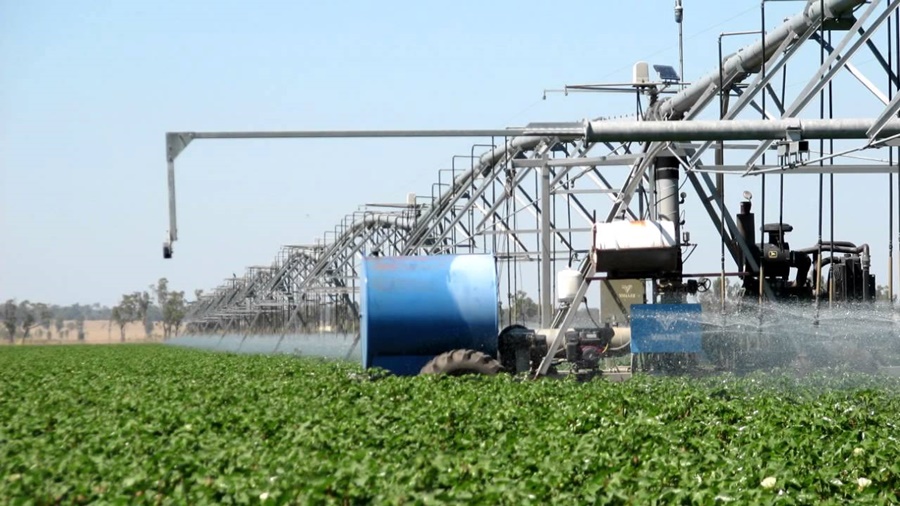
Center Pivot Irrigation is highly efficient for large circular fields, typically covering around 120 acres per system, while Lateral Move Irrigation excels with rectangular plots, providing precise water delivery across diverse shapes. Both systems enhance crop yields and optimize water usage, making them vital in modern agriculture. Recognizing their design and operational differences is key to maximizing irrigation effectiveness.
Understanding the differences between these irrigation methods helps farmers choose the most suitable system for their land, crop type, and budget. This article provides a detailed comparison of Center Pivot Irrigation and Lateral Move Irrigation, highlighting their advantages, disadvantages, and ideal applications.
What is Center Pivot Irrigation?
Center Pivot Irrigation is a mechanized irrigation system that rotates around a fixed central point. The system consists of a long pipeline supported by towers with wheels. Water is pumped through the pipeline and distributed through sprinklers mounted along its length.
As the system rotates around the central pivot, it irrigates a circular area. The resulting field pattern is circular, which is easily recognizable from aerial photographs.
Key Components
- Central pivot point
- Water supply system
- Sprinkler pipeline
- Drive towers and wheels
- Control panel
- End gun sprinkler (optional)
How It Works
Water enters the pivot from the center and travels through the pipeline. The towers move slowly around the pivot point, allowing sprinklers to apply water evenly over the field. Depending on the system design, fertilizers and chemicals can also be applied through the irrigation water.
What is Lateral Move Irrigation?
Lateral Move Irrigation, also known as Linear Move Irrigation, operates similarly to a center pivot but moves in a straight line across the field rather than rotating around a central point.
The entire machine travels laterally from one side of the field to the other while continuously irrigating crops. Water is supplied through a canal, hose, or dedicated water feed system that moves along with the machine.
Key Components
- Linear pipeline
- Drive towers
- Sprinklers
- Guidance system
- Water supply connection
- Control system
How It Works
The irrigation machine moves horizontally across a rectangular field while sprinklers distribute water evenly. Once it reaches the opposite end, it may return to the starting position or continue operation according to the irrigation schedule.
Major Differences Between Center Pivot and Lateral Move Irrigation
1. Field Coverage Pattern
Center Pivot Irrigation
- Covers a circular area.
- Leaves field corners unirrigated unless corner systems are installed.
- Best suited for fields where circular coverage is acceptable.
Lateral Move Irrigation
- Covers rectangular and square fields efficiently.
- Provides nearly 100% field coverage.
- Minimizes wasted land.
2. Water Distribution Efficiency
Center Pivot
- Highly efficient water application.
- Uniform distribution when properly maintained.
- Efficiency typically ranges from 80% to 95%.
Lateral Move
- Similar efficiency levels.
- Often achieves more uniform coverage on rectangular fields.
- Better utilization of available land.
3. Land Utilization
Center Pivot
- Circular irrigation leaves unused corners.
- Total irrigated area may be lower than total field area.
Lateral Move
- Irrigates almost the entire field.
- Maximizes productive land use.
4. Installation Requirements
Center Pivot
- Easier installation.
- Requires a fixed central water source.
- Less complex infrastructure.
Lateral Move
- More complicated installation.
- Requires continuous water supply along the travel path.
- Needs accurate guidance systems.
5. Cost
Center Pivot
- Generally lower initial investment.
- Lower maintenance complexity.
- Widely available and commonly used.
Lateral Move
- Higher installation costs.
- Additional expense for water delivery systems.
- More sophisticated control technology.
6. Field Shape Compatibility
Center Pivot
- Ideal for large, open, relatively square fields.
- Performs best on fields where circular irrigation is acceptable.
Lateral Move
- Excellent for rectangular fields.
- Suitable for farms requiring full field coverage.
- Common in large commercial farming operations.
7. Energy Consumption
Center Pivot
- Usually consumes less energy.
- Simpler movement mechanism.
Lateral Move
- May require slightly more energy due to continuous linear travel and guidance systems.
Advantages of Center Pivot Irrigation
Water Conservation
Center pivot systems can achieve high water-use efficiency, reducing water waste compared to traditional surface irrigation methods.
Lower Labor Requirements
Automation minimizes manual labor and allows farmers to manage large fields efficiently.
Flexible Application
The system can apply:
- Water
- Fertilizers
- Herbicides
- Pesticides
Adaptability
Modern systems include advanced technologies such as:
- GPS guidance
- Remote monitoring
- Variable rate irrigation
- Soil moisture sensors
Lower Capital Cost
Compared to many large-scale irrigation alternatives, center pivots are often more affordable.
Disadvantages of Center Pivot Irrigation
Unirrigated Corners
Circular operation leaves portions of square fields dry unless corner extensions are installed.
Limited Field Shape Flexibility
Irregularly shaped fields may not be suitable.
Obstructions
Trees, power lines, and buildings can interfere with system movement.
Advantages of Lateral Move Irrigation
Maximum Land Coverage
Lateral systems can irrigate nearly every square meter of a rectangular field.
Uniform Water Application
Straight-line movement provides highly consistent irrigation patterns.
Ideal for Large Farms
Commercial farms with extensive rectangular fields benefit greatly from linear irrigation.
Better Land Productivity
Since fewer areas remain unirrigated, overall crop production may increase.
Disadvantages of Lateral Move Irrigation
Higher Initial Cost
The infrastructure needed for water supply and guidance systems increases investment costs.
Complex Water Delivery
A reliable water source must be available along the machine’s entire travel path.
More Maintenance
Additional moving parts and control systems may require regular servicing.
Crop Suitability
Both systems are suitable for a wide variety of crops, including:
- Wheat
- Corn (Maize)
- Soybeans
- Cotton
- Alfalfa
- Potatoes
- Vegetables
- Sugar beet
- Forage crops
The choice depends more on field layout than crop type.
Environmental Impact
Both irrigation methods contribute to sustainable agriculture by:
- Reducing water losses
- Improving irrigation precision
- Lowering runoff
- Minimizing soil erosion
- Supporting efficient fertilizer application
When equipped with modern technology, both systems can significantly improve water conservation compared to flood irrigation.
Which System Should Farmers Choose?
Choose Center Pivot Irrigation If:
- Your fields are large and relatively square.
- A central water source is available.
- You want lower installation costs.
- Some loss of corner area is acceptable.
- Simplicity and reliability are priorities.
Choose Lateral Move Irrigation If:
- Your fields are rectangular.
- Maximum land utilization is important.
- You have access to a continuous water supply system.
- Higher initial investment is acceptable.
- Full field coverage is required.
Conclusion
Center Pivot Irrigation and Lateral Move Irrigation are both highly effective mechanized irrigation systems that improve agricultural productivity and water-use efficiency. Center Pivot systems are generally more economical, simpler to install, and widely adopted around the world. In contrast, Lateral Move systems offer superior land coverage and are ideal for rectangular fields where maximizing irrigated acreage is a priority.
The best choice depends on field shape, water availability, budget, and long-term production goals. By carefully evaluating these factors, farmers can select the irrigation system that delivers the greatest return on investment while promoting sustainable agricultural practices.