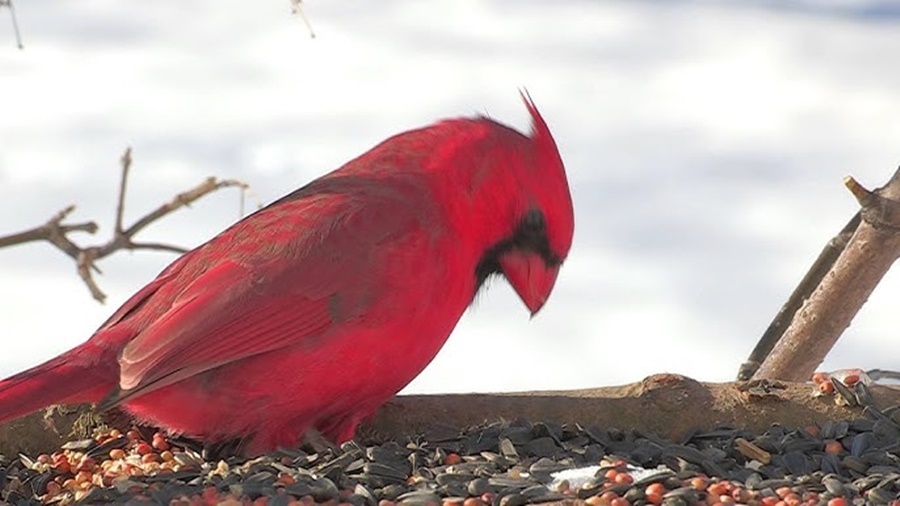
Bright red birds often catch the eye, especially when they appear against green trees or snowy landscapes. The Northern Cardinal is the most famous red bird in North America, but it is far from the only one. Many people confuse cardinals with other red or reddish birds such as tanagers, finches, and crossbills. This article explains how to clearly tell the Northern Cardinal apart from other red birds by looking at color, shape, behavior, habitat, and sound.
1. The Northern Cardinal: Key Identification Features
The Northern Cardinal (Cardinalis cardinalis) is a medium-sized songbird known for its vivid color and distinctive appearance.
Color
- Male Northern Cardinals are bright crimson red all over.
- They have a black mask around the face and throat.
- The bill is thick, cone-shaped, and bright orange or reddish-orange.
- Females are not bright red; instead, they are light brown or grayish with red accents on the wings, tail, and crest.
Crest
- Cardinals have a prominent pointed crest on top of their head.
- The crest can be raised or lowered depending on mood.
Size and Shape
- About 8–9 inches long, larger than many finches.
- Stocky body with a long tail.
Behavior
- Cardinals are often seen alone or in pairs.
- They frequently visit backyard feeders.
- Unlike many birds, cardinals do not migrate and stay in the same area year-round.
Sound
- Cardinals are known for loud, clear whistles such as “cheer-cheer-cheer” or “birdy-birdy-birdy.”
- Both males and females sing.
2. Scarlet Tanager vs. Northern Cardinal
The Scarlet Tanager is one of the most commonly confused birds with the male cardinal.
Key Differences
- Scarlet Tanager males are bright red but have jet-black wings and tails, unlike the all-red cardinal.
- Tanagers do not have a crest.
- Their bill is paler and less thick than a cardinal’s.
- Scarlet Tanagers are usually seen high in forest canopies, not at feeders.
- Females are yellowish-green, not brown with red accents.
Habitat
- Scarlet Tanagers prefer dense forests, especially during breeding season.
- Cardinals are more common in suburbs, gardens, and woodland edges.
3. Summer Tanager vs. Northern Cardinal
The Summer Tanager is another red bird often mistaken for a cardinal.
Key Differences
- Male Summer Tanagers are uniform red, but the red is often softer or rosy, not as intense.
- They lack a black facial mask.
- Their bill is larger and more pale, sometimes grayish.
- No crest is present.
- Females are mustard yellow rather than brown.
Behavior
- Summer Tanagers often feed on bees and wasps, catching them in mid-air.
- Cardinals mainly eat seeds, fruits, and insects.
4. House Finch vs. Northern Cardinal
House Finches are common and frequently confused with cardinals, especially by beginners.
Key Differences
- Male House Finches are brownish with red patches, not fully red.
- The red is usually limited to the head, chest, and rump.
- Their bill is smaller and less powerful.
- House Finches do not have a crest.
- Females are streaked brown with no red at all.
Size
- House Finches are smaller and slimmer than cardinals.
5. Purple Finch vs. Northern Cardinal
Despite the name, Purple Finches often look reddish.
Key Differences
- Purple Finch males appear raspberry or wine-colored, mixed with brown.
- Their color looks “washed” over the body rather than solid red.
- No crest and no black mask.
- Bill is shorter and less thick.
Habitat
- Purple Finches are more common in coniferous forests and colder regions.
6. Red Crossbill vs. Northern Cardinal
The Red Crossbill looks unusual and is less often mistaken, but confusion can happen at a distance.
Key Differences
- Crossbills have a crossed or twisted bill, adapted for extracting seeds from pine cones.
- Color is red-orange rather than bright crimson.
- No crest or facial mask.
- They often travel in flocks, unlike cardinals.
7. Habitat and Location Clues
Location can greatly help with identification:
- Northern Cardinals: Eastern and central United States, southern Canada, and Mexico; common in yards, parks, and shrublands.
- Tanagers: Mostly forest birds, often high in trees.
- Finches: Often in flocks, near feeders, or in open woodlands.
If you see a red bird at a backyard feeder in winter, it is very likely a Northern Cardinal.
8. Quick Comparison Summary
| Feature | Northern Cardinal | Other Red Birds |
|---|---|---|
| Crest | Yes | Usually no |
| Face Mask | Black mask | Absent |
| Bill | Thick, orange-red | Smaller or paler |
| Color | Solid bright red (male) | Often mixed with brown or black |
| Habitat | Yards, shrubs, feeders | Forests or open areas |
| Migration | Non-migratory | Many migrate |
Conclusion
The Northern Cardinal stands out from other red birds thanks to its bright red color, black facial mask, thick orange bill, and raised crest. While other birds may share red coloring, they usually lack one or more of these key traits. By paying attention to shape, behavior, habitat, and sound, birdwatchers can confidently tell a Northern Cardinal from other red birds.